
Most travelers who book a France trip immediately think Paris, then Cannes, then Nice. And while those cities absolutely deserve their reputation, they tell only one story about this country. The real France — raw, quiet, and astonishing — lives in places far from those spotlights. The underrated medieval villages France are where that other story unfolds. Stone archways draped in wisteria, market squares untouched by modernity, and locals who nod hello like you’ve always belonged there. If you’re planning a French escape in 2026 and want something genuinely memorable, these hidden medieval towns in France are your answer.
This guide covers eight of the most remarkable yet overlooked villages — complete with what to eat, where to stay, and exactly why each one deserves a spot on your itinerary.
Why Travelers Are Choosing Villages Over Cities in 2026
There’s a quiet revolution happening in travel. Visitors are increasingly walking away from overcrowded tourist hotspots and heading toward off-the-beaten-path villages in France that offer authenticity over aesthetics. Sustainable slow travel is no longer a niche concept — it’s the mainstream preference of 2026 travelers.
And the timing couldn’t be better. Many of France’s historic small towns have invested in infrastructure: reliable WiFi, better road access, and boutique accommodation that rivals anything you’d find in Paris. You no longer have to sacrifice comfort to escape the crowds.
1. Saint-Guilhem-le-Désert — Spiritual Silence in the Hérault Valley
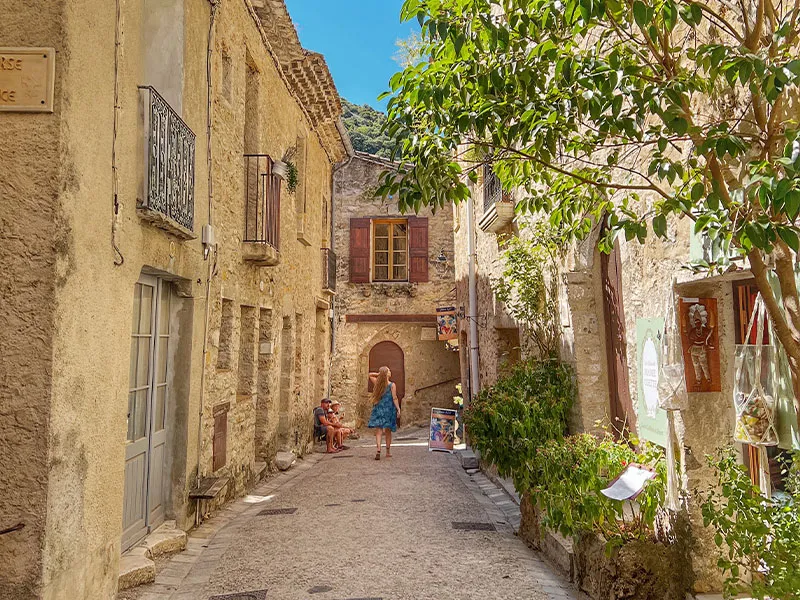
Nestled deep in the Gellone Valley, Saint-Guilhem-le-Désert is one of those underrated medieval villages France rarely gets credit for outside pilgrim circles. Built around the 804 AD Abbey of Gellone — a UNESCO World Heritage stop on the Santiago de Compostela route — this village carries a quiet spiritual weight that few places can replicate.
Golden limestone buildings press together along lanes barely wide enough for two people. Arrive after 6 PM and you’ll often have the village almost entirely to yourself, which is extraordinary given how beautiful it is.
Where to Stay: La Taverne de l’Escuelle — historic guesthouse with stone interiors and a courtyard garden. Where to Eat: Restaurant L’Oustal Fondu — locally raised lamb cooked low and slow, the way it’s been done here for generations.
LSI tip for readers: This village pairs perfectly with a hike through the nearby Hérault Gorges.
2. Minerve — A Cathar Fortress Carved by Rivers
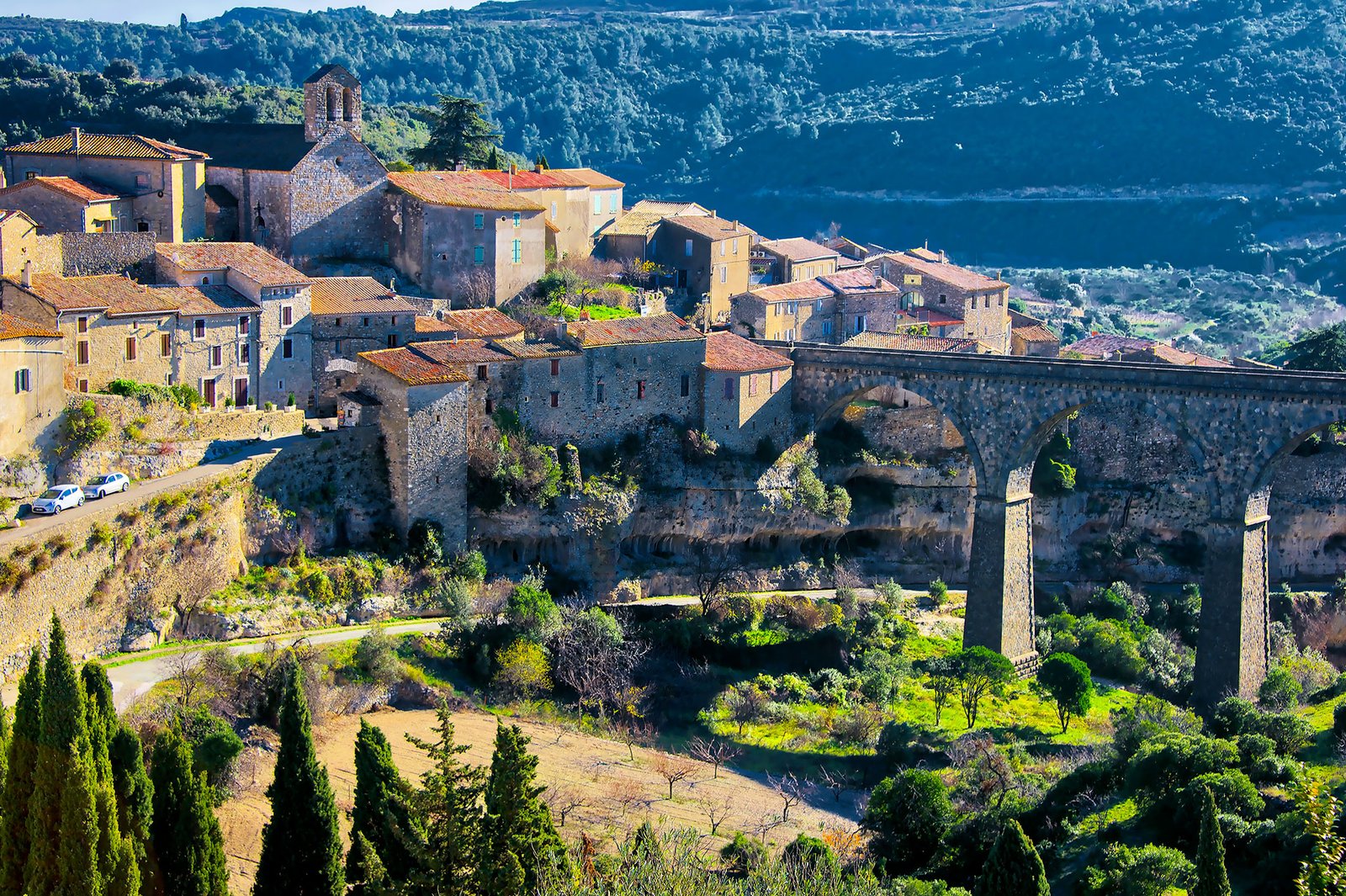
Few medieval villages in southern France have the dramatic presence of Minerve. Sitting on a limestone plateau, naturally flanked by the Brian and Cesse rivers that carved deep canyons over millennia, Minerve doesn’t just look like a fortress — it was one.
In 1210, it became the tragic site of the Cathar Crusade’s most famous siege. Today, visitors can walk through the river-carved rock tunnels that dry up each summer, wander the tiny village square, and feel an almost tangible connection to a turbulent past. It’s one of the most authentic medieval experiences in France that most tourists never find.
Where to Stay: Chambres d’Hôtes Le Relais de Chantovent — canyon-view rooms with genuine charm.
Where to Eat: Les Deux Vallées — order the cassoulet; it’s slow-cooked perfection.
3. Moustiers-Sainte-Marie — The Village Under a Star
There’s a golden star suspended on a chain between two limestone cliffs high above Moustiers-Sainte-Marie. Nobody is entirely sure when it was first placed there, which somehow makes it more magical.
This hidden gem in Provence has been the center of France’s faïence pottery tradition since the 17th century. Wandering through small workshops where artisans hand-paint glazed ceramics is one of the most unexpectedly absorbing ways to spend a morning in France. The village itself feels half-carved into the mountain — waterfalls trickle between houses, and lavender perfumes every street corner.
Where to Stay: La Bastide de Moustiers — Alain Ducasse’s countryside retreat, refined but unpretentious. Where to Eat: La Treille Muscate — riverside dining with a seasonal Provençal menu.
4. Cordes-sur-Ciel — The Village That Floats Above the Clouds
Founded in 1222, Cordes-sur-Ciel sits at such elevation that on misty mornings, the valley below disappears entirely — leaving the village floating in white. The name literally means “Cordes in the Sky,” and once you’ve seen it on a foggy October morning, you’ll understand why.
What makes Cordes one of the best underrated medieval villages France has to offer is its thriving arts community. Forget mass-produced souvenirs. Here you’ll find hand-blown glass, original oil paintings, bespoke leather goods, and ceramics that are actually worth bringing home. This is the medieval French village that rewards slow wandering.
Where to Stay: Hostellerie du Vieux Cordes — a 700-year-old building that functions as a hotel and shouldn’t work as well as it does. Where to Eat: Au Gaufrier — try the almond Galette de Cordes before you leave. You won’t forget it.
5. Beynac-et-Cazenac — Castle Above the Dordogne
Perched above a bend in the Dordogne River, Beynac-et-Cazenac is anchored by a castle that played a real strategic role during the Hundred Years’ War. The view from the ramparts — river, forest, other châteaux in the distance — is one of the finest in all of rural France.
The smartest way to experience this hidden medieval village in France is by boat. A traditional gabare river boat drifts beneath cliffs that seem impossible to build on, letting you see the castle walls from below as medieval soldiers once saw approaching armies. It’s theatrical and completely genuine.
6. Gassin — The French Riviera’s Quieter Secret
Saint-Tropez sits in gridlock while Gassin, just minutes away and several hundred meters higher, stays blissfully calm. One of the most offbeat places in southern France, this hilltop village offers vineyard views, Mediterranean sea panoramas, and a quality of light in the late afternoon that photographers chase for hours.
L’Androuno — reportedly one of the world’s narrowest streets — squeezes through the village center. In 2026, many local vineyards now run sunset tasting sessions paired with those sweeping views, making Gassin the ideal choice for a slow, romantic evening away from the Riviera’s famous chaos.
7. Pérouges — A Living Film Set Near Lyon
Pérouges is what happens when a medieval French village survives completely intact. Double fortification walls, timber-framed houses, and uneven cobblestones that filmmakers have used for decades — including multiple Three Musketeers productions. It sits 35 kilometers from Lyon and feels like a different century.
The must-eat here is the Galette de Pérouges: a warm, paper-thin pastry made with butter, sugar, and lemon that has been the village’s signature since the 14th century. Simple, perfect, unforgettable.
8. Locronan — Brittany’s Granite Masterpiece
Every building in Locronan is built from the same dark granite, giving this historic French village a moody, cinematic uniformity that photographers adore. In the 16th century, it supplied canvas for the French royal navy. Today, there are no visible power lines, no modern signage, and no chain stores — just streets that look exactly as they did four hundred years ago.
Visit during the Grand Troménie pilgrimage (held every six years, next in 2028) and the village fills with thousands of people in traditional Breton costume for one of France’s most distinctive cultural events.
Quick Village Comparison Guide
| Village | Best For | Crowd Level | Daily Budget |
|---|---|---|---|
| Saint-Guilhem | Pilgrimage & history | Very low | €95 |
| Minerve | Geology & Cathar history | Very low | €80 |
| Moustiers | Romance & ceramics | Moderate | €130 |
| Cordes-sur-Ciel | Art lovers & walkers | Low | €100 |
| Beynac-et-Cazenac | Castle history & river | Low | €110 |
| Gassin | Riviera views & wine | Low | €160 |
| Pérouges | Day trips from Lyon | Moderate | €100 |
| Locronan | Photography & Brittany culture | Low | €90 |
What to Eat in France’s Medieval Villages
Eating in these French countryside villages is one of the great pleasures of this kind of trip. Don’t rush it. Look for:
- Magret de Canard — duck breast with cherry or honey reduction
- Cassoulet — a slow-cooked white bean and meat stew from the Languedoc
- Roquefort — world-famous blue cheese aged in nearby limestone caves
- Black Truffles — available in winter markets across the Périgord
- Lavender Honey Ice Cream — a Provence staple worth every calorie
Practical Tips for Visiting Medieval Villages in France
- Rent a small car — medieval village streets were built for horses, not SUVs
- Carry cash — many village bakeries and market stalls don’t accept cards under €10
- Book stays through Gîtes de France for genuine local accommodation
- Arrive early or late — most tour groups pass through between 10 AM and 3 PM
- Learn three words: “Bonjour,” “Merci,” and “C’est magnifique” — locals respond warmly
Ready to Plan Your French Village Escape?
The underrated medieval villages France aren’t just travel destinations — they’re the kind of places that quietly rearrange your sense of what travel is supposed to feel like. No queues, no Instagram crowds, no disappointment. Just real history, real food, and real quiet.
Have a question about planning your trip? Contact us — we’d love to help you build the perfect French village itinerary.
Want more France inspiration? Explore our full France travel guide →