
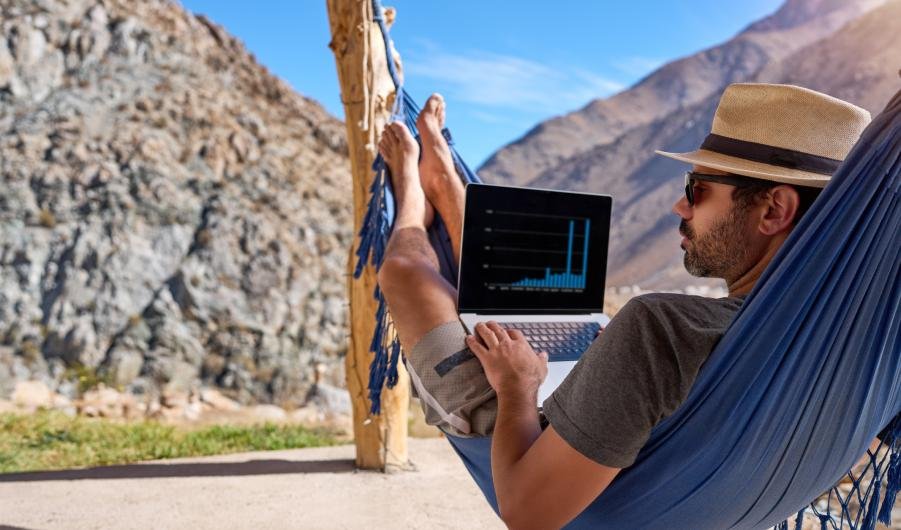
Whether you’re planning your first remote work trip or you’ve been living out of a backpack for years, this digital nomad travel guide is your go-to resource for making location-independent living both sustainable and deeply rewarding. From choosing the best destinations to managing taxes and staying productive on the road, we cover everything you need to know.
What Is a Digital Nomad? (And Why Millions Are Making the Switch)
A digital nomad is someone who leverages technology to work remotely while traveling — often across multiple countries. Thanks to the explosive growth of remote work, co-working infrastructure, and affordable international flights, the digital nomad lifestyle has shifted from a niche experiment to a mainstream career choice.
According to recent estimates, there are over 35 million digital nomads worldwide, a number that’s been climbing sharply since the post-pandemic remote work boom. If you’re reading this digital nomad travel guide, you’re likely considering joining them — and with the right preparation, it’s absolutely achievable.
Choosing Your First Destination: What Actually Matters
The biggest mistake first-timers make is choosing a destination based on aesthetics alone. A beautiful city means nothing if the WiFi is unreliable, the cost of living wrecks your budget, or the visa situation forces you out after 30 days.
Here’s what to evaluate before you book:
1. Internet Speed and Reliability
Remote work lives and dies on connectivity. Look for destinations with average speeds above 25 Mbps and co-working spaces as a backup. Cities like Chiang Mai, Medellín, Tbilisi, and Lisbon consistently top the charts for reliable infrastructure.
2. Cost of Living vs. Your Income
The beauty of this lifestyle is geographic arbitrage — earning in a strong currency while living in a more affordable economy. A solid benchmark: aim for a destination where your monthly budget is 40–60% of what it would cost in your home country.
3. Visa and Legal Status
Overstaying a visa is not worth the risk. Many countries now offer digital nomad visas specifically designed for remote workers — Portugal, Croatia, Greece, Costa Rica, and Indonesia (Bali) all have formal programs. Always verify current entry requirements before you go.
4. Community and Social Infrastructure
Loneliness is the most underreported challenge of nomadic life. Cities with active Nomad List communities, regular meetups, and co-living spaces make it significantly easier to build connections abroad.
Top Destinations Featured in Every Serious Digital Nomad Travel Guide
No digital nomad travel guide would be complete without a destination breakdown. Here are some of the most nomad-friendly cities globally, broken down by region:
Southeast Asia
- Chiang Mai, Thailand — Affordable, warm, excellent food scene, strong expat community. Monthly budget: ~$900–$1,400.
- Canggu, Bali, Indonesia — Vibrant surf culture, world-class co-working spaces, and an active nomad scene. Monthly budget: ~$1,200–$1,800.
- Ho Chi Minh City, Vietnam — Fast-paced city with ultra-fast fiber internet and some of the cheapest street food on the planet.
Europe
- Lisbon, Portugal — One of Europe’s most popular nomad hubs. Warm climate, English widely spoken, Schengen access. Monthly budget: ~$2,000–$2,800.
- Tbilisi, Georgia — Tax-friendly (0% income tax for many foreign remote workers), incredibly affordable, and historically rich.
- Split, Croatia — Stunning Adriatic coastline with a growing remote work scene and an official digital nomad visa.
Latin America
- Medellín, Colombia — Nicknamed the “City of Eternal Spring” for its perfect weather. Dynamic startup ecosystem and low cost of living.
- Mexico City, Mexico — World-class food, culture, and nightlife. A growing tech scene and large nomad community in neighborhoods like Roma Norte.
Building Your Remote Work Setup on the Road
Your gear and digital tools are your office. Here’s what experienced nomads recommend:
Must-Have Hardware
- Laptop: MacBook Pro or Dell XPS for reliability. Always bring a backup power adapter.
- Noise-canceling headphones: Essential for calls in busy co-working spaces or cafés.
- Portable WiFi router or eSIM: Services like Airalo or Nomad eSIM let you stay connected across 100+ countries without swapping physical SIM cards.
- Portable laptop stand and compact keyboard: Your back will thank you within a week.
Essential Apps and Tools
- NordVPN or ExpressVPN — Protect your data on public networks and access home-country content.
- Notion or Obsidian — Centralized project and life management.
- Wise (formerly TransferWise) — Multi-currency account with near-interbank exchange rates, a non-negotiable for international banking.
- Nomad List — Data-driven destination research with real-time cost-of-living and internet speed scores.
- Google Fi or local SIM — Communication essentials.
Managing Money as a Location-Independent Worker
Financial management is where many nomads struggle. Here’s a practical framework:
Banking
Open accounts that don’t charge foreign transaction fees. Charles Schwab (US-based) refunds all global ATM fees worldwide — it’s a nomad staple. In Europe, Revolut and N26 offer similar benefits.
Taxes
This is the most complex part of any digital nomad travel guide and varies hugely by nationality. Key questions to answer with a qualified tax professional:
- Do you still owe taxes in your home country while abroad?
- Does your destination country tax foreign-sourced income?
- Are you eligible for the US Foreign Earned Income Exclusion (FEIE) or similar mechanisms?
Countries like Georgia, Paraguay, and Panama have territorial tax systems, meaning foreign-sourced income is generally not taxed there — making them popular among long-term nomads.
Health Insurance
Never travel without it. International health insurance providers like SafetyWing, Cigna Global, and IMG Global offer plans tailored for nomads, ranging from budget-friendly travel medical coverage to comprehensive international health plans.
Productivity Hacks for Working Across Time Zones
Maintaining productivity while navigating new environments, jet lag, and the constant pull of adventure is a genuine skill. Here’s what works:
1. Protect your deep work hours. Identify your peak cognitive hours and treat them as sacred, regardless of what city you’re in. If you do your best work between 9–12 AM, guard that window.
2. Use time zone overlap strategically. If your clients or team are based in New York, Southeast Asia can be challenging — but Latin America or Eastern Europe offers much more overlap. Factor this into destination decisions.
3. Build location rituals. The brain thrives on routine. Create a “start work” ritual — a specific café, a playlist, a morning walk — that signals to your brain it’s time to focus, even in an unfamiliar city.
4. Batch travel admin. Visa applications, accommodation hunting, and flight booking are cognitive bandwidth drains. Dedicate specific days to logistics rather than letting them bleed into work hours.
5. Embrace co-working spaces. Home cafés and Airbnbs have unreliable WiFi. A co-working day pass ($10–$20 in most cities) buys you stable internet, a proper desk, and often a community of fellow remote workers.
The Slow Travel Philosophy: Why Less Is More
One of the most valuable shifts in mindset covered in this digital nomad travel guide is the move from fast travel to slow travel. Jumping between cities every few days is exhausting, expensive, and counterproductive to both work and genuine cultural immersion.
Most experienced nomads recommend staying at least 4–6 weeks in a single location. This gives you time to:
- Negotiate monthly rent rates (dramatically cheaper than nightly)
- Find your go-to coffee shop, gym, and grocery store
- Build real friendships rather than surface-level hostel connections
- Actually experience the rhythm of local life
Mental Health and Loneliness: The Honest Conversation
No honest digital nomad travel guide skips this topic. The lifestyle is genuinely liberating — and it can also be genuinely isolating. Research shows that while nomads report high levels of freedom and satisfaction, they also experience elevated rates of loneliness, anxiety, and burnout compared to location-based workers.
Strategies that help:
- Commit to co-living spaces at least occasionally. Buildings like Outsite, Selina, and Common offer ready-made communities.
- Keep relationships home strong. Schedule regular video calls with family and close friends. Don’t let geographic distance become emotional distance.
- Prioritize physical health. Exercise is the single most evidence-backed intervention for mood regulation. Find a gym or yoga studio in every city you land in.
- Consider therapy. Online therapy platforms like BetterHelp work from anywhere in the world and are worth the investment.
Packing Light: The Nomad’s Golden Rule
The ultimate digital nomad travel guide principle on packing: if you can’t carry everything you own through a busy airport without checking a bag, you’ve packed too much. The one-bag lifestyle isn’t just about convenience — it eliminates baggage fees, reduces decision fatigue, and makes spontaneous itinerary changes effortless.
The nomad community broadly converges on a few bag favorites: the Osprey Farpoint 40, Peak Design Travel Backpack 45L, and Tortuga Setout 45L. These fit within carry-on limits on most airlines while holding everything you need for months of travel.
Packing principles:
- One pair of shoes that works for both work meetings and day hikes
- Merino wool clothing (odor-resistant, packs small, works in most climates)
- All electronics and chargers in a single tech pouch
- Enough medication and toiletries for 30 days; restock locally
Legal Considerations: Visas, Registration, and Local Laws
Every digital nomad travel guide should emphasize this: working remotely in a foreign country on a tourist visa is technically illegal in many jurisdictions. Most countries don’t enforce it aggressively for short stays, but the legal risk is real — especially as enforcement tightens.
Practical steps:
- Research the specific visa category that applies to your situation
- Consider dedicated digital nomad visa programs where available
- Use services like iVisa or VisaHQ to streamline applications
- Keep digital and physical copies of all important documents (passport, insurance, emergency contacts)
Final Thoughts
This digital nomad travel guide has covered the essentials — from choosing destinations and managing your finances, to protecting your mental health and building community. The digital nomad lifestyle offers a genuinely extraordinary way to experience the world while building a career. Done thoughtfully, it can be one of the most enriching chapters of your professional and personal life.
The key word is thoughtfully. Research your visa. Buy the health insurance. Stay longer in fewer places. Invest in community. These aren’t optional extras — they’re what separate people who thrive from people who burn out and go home after three months.
Your adventure starts with a single booked flight. The rest, you figure out as you go.
Contact Us
Have questions about the digital nomad lifestyle? Want personalized destination advice or help planning your first remote work trip?
We’d love to hear from you. Whether you’re just starting to explore location independence or you’re a seasoned nomad looking for your next base, our team is here to help.
👉 Get in Touch With Us Today — Fill out our contact form and we’ll get back to you within 24 hours.